Thursday, June 10, 2010

Exam

QuestionDescribe the importance of water in the ancient world.


Thesis: In the developing times of the ancient world water, which people used in almost every single thing they did, was the most important resource on the earth. 


Primary Source #1:
" The Greek cities are thought to have flourished mainly on account of the felicitous choice made by their founders, in regard to the beauty and strength of their sites, their proximity to some haven, and the fineness of the country. But the Roman prudence was more particularly employed on matters which have received but little attention from the Greeks---such as paving their roads, constructing aqueducts, and sewers. In fact they have paved the roads, cut through hills, and filled up valleys, so that the merchandise may be conveyed by carriage from the ports. The sewers, arched over with hewn stones, are large enough in parts for actual hay wagons to pass through, while so plentiful is the supply of water from the aqueducts, that rivers may be said to flow through the city and the sewers, and almost every house is furnished with water pipes and copious fountains.
Ancient History Sourcebook: Strabo (64/3 BCE- c.21 CE):The Grandeur of Rome, c. 20 CE from Geography, V.iii
http://www.fordham.edu/halsall/ancient/strabo5-rome.html 

 Primary Source #2: 
"Frequently praise is given to the great sewer system of Rome. There are seven "rivers" made to flow, by artificial channels, beneath the city. Rushing onward like so many impetuous torrents, they are compelled to carry off and sweep away all the sewerage; and swollen as they are by the vast accession of the rain water, they reverberate against the sides and bottoms of their channels. Occasionally too the Tiber, overflowing, is thrown backward in its course, and discharges itself by these outlets."
 Ancient History Sourcebook: Pliny the Elder  (23/4-79 CE):The Grandeur of Rome, c. 75 CE from Natural History
http://www.fordham.edu/halsall/ancient/pliny-natihist-rome.html 

Primary Source #3:
"The river of Bel (?) Nanna fills with water.                                                                                The brilliant (?) river Nanna fills with water.                                                                            The river Diglat [Tigris] Nanna fills with water.                                                                       The brilliance of the Purattu [Euphrates] Nanna fills with water.                                                       The canal with its gate Lukhe, Nanna fills with water.                                                                  The great marsh and the little marsh Nanna fills with water."                                                 
          Ancient History Sourcebook: A Collection of Babylonian Prayers, c. 1600 BCE
http://www.fordham.edu/halsall/ancient/1600babylonianprayers.html
Explanation of Argument:
     The first and second sources narrate how the city of Ancient Rome is becoming dependent on water. The first source explain water in the home. Every house has plumbing, an aspect of home life that never left since they installed it. The second source highlights how water is being used to the advantages of the citizens outside of their homes. The water is utilized to serve many different functions, even to clean up the city. The third source is an excerpt from Ancient Babylonian prayers. Water is a clear symbol in the passage; there is a god of water, Nanna, that created all of the waters of the world. So, water was a key aspect of life in the ancient world.
-------------------------------------------------------------------------------------------------------------

Question: Who is a better model for modern historians: Herodotus or Thucydides? Why?


Thesis: Thucydides and his comprehensive study of the Peloponnesian War is a much better model for modern historians than Herodotus and his work The Histories. 


Primary Source #1:

"As for Artayctes, and the troops with him, who had been the last to leave the town, they were overtaken by the Greeks, not far from Aegospotami, and defended themselves stoutly for a time, but were at last either killed or taken prisoners. Those whom they made prisoners the Greeks bound with chains, and brought with them to Sestos. Artayctes and his son were among the number."

The History of Herodotus By Herodotus Written 440 B.C Book IX


         The History of the Peloponnesian War By Thucydides

 http://classics.mit.edu/Thucydides/pelopwar.3.third.html


Primary Source #3:
"He speaks in places as if his object was to record the wars between the Greeks and the barbarians; but as he omits the Trojan war, in which he fully believes, the expedition of the Teucrians and Mysians against Thrace and Thessaly, the wars connected with the Ionian colonization of Asia Minor and others, it is evident that he does not really aim at embracing in his narrative all the wars between Greeks and barbarians with which he was acquainted. Nor does it even seem to have been his object to give an account of the entire struggle between Greece and Persia. That struggle was not terminated by the battle of Mycale and the capture of Sestos in 479 B.C. It continued for thirty years longer, to the peace of Callias."
Ancient History Sourcebook: 11th Brittanica Herodotus 
 http://www.fordham.edu/halsall/ancient/eb11-herodotus.html
Explanation of Argument:
     The first and second sources are excerpts from each of the historians most famous histories. It is evident by the excerpts that Thucydides was a better historian than Herodotus. Thucydides said exactly where and when the subject was and what was happening exactly. Herodotus only wrote about certain events. This is even more obvious when the Brittanica says that Herodotus had incorrect dates and omitted events. Thucydides is a better example for modern historians than Herodotus.
--------------------------------------------------------------------------------------------

Question:  Considering all of the conflict of the first century BCE, was Rome better off as an 'empire' than as a republic?


Thesis: All of Rome: the city life, the government, the conquers, and everything in between fared much better when Rome was officially a Republic. 


Primary Source #1: 
"If he (plaintiff) summon him (defendant) into court, he shall go. If he does not go, (plaintiff) shall call witnesses. Then only he shall take him by force. If he refuses or flees, he (plaintiff) shall lay hands on him. If disease or age is an impediment, he shall grant him a team (of oxen). He shall not spread with cushions the covered carriage if he does not wish to."
THE TWELVE TABLES (451-450 B.C.)
 http://www.csun.edu/~hcfll004/12tables.html

Primary Source #2:
 "The military stipends are thus regulated. The pay of a soldier in the infantry is two obols by the day; and double to the centurions. The pay of the cavalry is a drachma. The allowance of corn to each man in the infantry consists of about two-third parts of an Attic bushel of wheat by the month. In the cavalry, it is seven bushels of barley, and two of wheat. To the infantry of the allies the same quantity is distributed as to that of the Romans: but their cavalry receives only one bushel and a third of wheat, and five of barley."
 Ancient History Sourcebook: Polybius (c.200-after 118 BCE):Rome at the End of the Punic Wars [History, Book 6]
 http://www.fordham.edu/halsall/ancient/polybius6.html

Primary Source #3:
 "My father, Drusus, was able to force Germany to submit, because behind him reigned a profound peace assured by the tranquillity of the Gauls. And note well, that at the moment he was summoned to that war, he was busy instituting the census in Gaul, a new institution among them, and contrary to their customs. And how difficult and perilous to us is this business of the census, although all we require is that our public resources should be known, we have learned by all too much experience.
 Ancient History Sourcebook: Claudius (b. 10 BCE, r. 41 CE - d.54 CE): A Discourse  in the Senate, c. 48 CE
 http://www.fordham.edu/halsall/ancient/48claudius.html
 Explanation of Argument:
     The first two sources relate to Rome when it was running as a Republican nation. There was a strict order of laws, as evidenced by the first source, that everyone had to follow and it made the city run smoothly. Also, in the second source, are even more examples of order. The third source  shows how Rome began to fall apart when it became an Empire. The Gauls were no longer peaceful to the Romans and Rome was in no way ready to defend. Rome was defeated as an Empire.
--------------------------------------------------------------------------------------------

Question: Were the Vikings "barbarians"?


Thesis: The Vikings, even though it seemed that they were pillaging and plundering to survive, were a violent race that can only be described as  "barbaric". 


Primary Source #1:
 "Pirates of the Northmen's race came to Nantes, killed the bishop and many of the clergy and laymen, both men and women, and pillaged the city. Thence they set out to plunder the lands of lower Aquitaine."
 Medieval Sourcebook: Three Sources on the Ravages of the Northmen in Frankland, c. 843 -    912
http://www.fordham.edu/halsall/source/843bertin.html
Primary Source #2:
"They went without shields, and were mad as dogs or wolves, and bit on their shields, and were as strong as bears or bulls; men they slew, and neither fire nor steel would deal with them; and this is what is called the fury of the berserker.''
Volsunga Saga, chapters 7-8 Going Berserk
 http://www.mircea-eliade.com/from-primitives-to-zen/145.html 

Primary Source #3:
"According to their custom the Northmen plundered eastern and western Frisia and burned down the town of Dordrecht, with two other villages, before the eyes of Lothair [The Emperor], who was then in the castle of Nimwegen, but could not punish the crime. The Northmen, with their boast filled with immense booty, including both men and goods, returned to their own country."
 Medieval Sourcebook: Annals of Xanten, 845-853
 http://www.fordham.edu/halsall/source/xanten1.html 
Explanation of Argument:


    The Vikings were a terrible force to be reckoned with and scared all of the other nations into submission. The first source describes how the Vikings pillage Holy Lands and destoryed messengers of God, bishops and the clergy. They wanted to burn and kill out of pleasure. The second source shows one of the most horrifying rituals in history, the Vikings who could fight almost bear-handed and win. The final source describes yet another plunder and hints that the Vikings may have taken slaves back to their country. The Vikings were the epitome of the word "barbarian".
--------------------------------------------------------------------------------------------
Question:  What was the significance of the Black Death and the 100 Years' War to the development of Europe as we know it today?


Thesis: The two major events of Medieval Europe, thusly, the Black Death and the Hundred Years' War, devastated the land and thrust the Europeans back in the timeline and they had to rebuild. 


Primary Source #1:
"And at first the deaths were a little more than the normal, then the mortality rose still higher, and afterwards the tale of dead reached five thousand each day, and again it even came to ten thousand. Now...each man attended to the burial of the dead of his own house, and these they threw even into the tombs of others...but afterwards confusion and disorder everywhere became complete. For slaves remained destitute of masters, and men...were deprived of the service of their domestics who were either sick or dead, and many houses became completely destitute of human inhabitants."

Medieval Sourcebook: Procopius: The Plague, 542

http://www.fordham.edu/halsall/source/542procopius-plague.html 

Primary Source #2:
 "At last, as it pleased God, the King seeing that too many of his liege subjects would be undone, and too much blood split, took pity in his heart, and granted them all pardon, on condition that they should never rise again, under pain of losing life or members, and that each of them should get his charter of pardon, and pay the King as fee for his seal twenty shillings, to make him rich. And so finished this wicked war."

Medieval Sourcebook: Anonimalle Chronicle: English Peasants' Revolt 1381

http://www.fordham.edu/halsall/source/anon1381.html 

Primary Source #3:
 "In the year 1349 there occurred the greatest epidemic that ever happened. Death went from one end of the earth to the other, on that side and this side of the sea, and it was greater among the Saracens than among the Christians. In some lands everyone died so that no one was left. Ships were also found on the sea laden with wares; the crew had all died and no one guided the ship. The Bishop of Marseilles and priests and monks and more than half of all the people there died with them."
 Jewish History Sourcebook: The Black Death and the Jews 1348-1349 CE
 http://www.fordham.edu/halsall/jewish/1348-jewsblackdeath.html 

Explanation of Argument:
     The first source is depicting the horrors of the Black Plague and how many people it affected. Not only did people die from it, but masters lost their slaves and did not know what to do without them. So, people who survived would have to buy new slaves, teach them how they wanted them to work, and basically start their lives over again. The second source describes the end of the Hundred Years War and how the king became rich. The money would be used for corrupt things and have an affect on all of Europe. The third source describes how people lost their religious rulers and how that had an impact on them.
--------------------------------------------------------------------------------------------
Question:  How does Henry VIII maintain power while breaking away from the Catholic Church?


Thesis: Henry VIII maintains power while breaking away from the Church because he has gained such prestige and power that people do not want to go against his word. 

Primary Source #1:


Friday, June 4, 2010

Exam Practice Theses

Describe the importance of water in the ancient world.
Water was the most important resource in the ancient world.


"...while so plentiful is the supply of water from the aqueducts, that rivers may be said to flow through the city and the sewers, and almost every house is furnished with water pipes and copious fountains." Strabo http://www.fordham.edu/halsall/ancient/strabo5-rome.html


"He [Agrippa] also formed 700 wells, in addition to 500 fountains, and 130 reservoirs, many of them magnificently adorned." Pliny the Elder http://www.fordham.edu/halsall/ancient/pliny-natihist-rome.html


"The brilliant river Nanna fills with water.
The river Diglat Nanna fills with water." Babylonian Prayers http://www.fordham.edu/halsall/ancient/1600babylonianprayers.html 

How does Henry VIII maintain power while breaking away from the Catholic Church and destroying monasteries and churches?

Why are Viking always depicted as wearing those hats with big horns on them? If they did in fact wear them, what kind of animal did they use to get them?


Monday, May 31, 2010

Greece Primary Sources

Description of Greece: Book 1: Attica - Pausanias wrote an in-depth travel guide. The travel guide started in Attica and passed through every single city of Greece. This certain Book, Attica, does exactly what the title implies: explains Attica as fully as possible. Every single thing about Attica is discussed from legends to daily life and everything in between.
"Ancient History Sourcebook: Pausanias: Description of Greece, Book I: Attica." FORDHAM.EDU. Web. 31 May 2010. <http://www.fordham.edu/halsall/ancient/pausanias-bk1.html>.

Selected Fragments - Written almost like a poem, this collection of works outlines Solon's attempts in Athenian politics. The word demos, the people, is used often, giving the impression that Solon was working towards some type of democratic rule. People have to forget all of their evils and work towards and only take what they need. Solon discusses with the gods and ponders on life.
"Solon, U. of Saskatchewan." Homepage. Web. 31 May 2010. <http://homepage.usask.ca/~jrp638/DeptTransls/Solon.html>.

Life of Solon - A bit of a biography of the man who wrote the poem previously discussed. Solon was a political poet and not much was known about him but that. Solon created laws and radical ideas for the city which he occupied. Remembered as a "legendary" he died 539 BCE.
"The Internet Classics Archive | Solon by Plutarch." The Internet Classics Archive: 441 Searchable Works of Classical Literature. Web. 31 May 2010. <http://classics.mit.edu/Plutarch/solon.html>.

The Persians Reject Democracy - Many people are speaking their views on which legal government shall be instilled. People speak and are refuted for their thoughts, rebuttal against and take sides. The Persians decide that there should be a monarchy but then there is the dilemma of who is to be the ruler, and it was Darius.
"Ancient History Sourcebook: Herodotus: The Persians Reject Democracy/Darius' State."FORDHAM.EDU. Web. 31 May 2010. <http://www.fordham.edu/halsall/ancient/herodotus-persdemo.html>.

The Melian Dialogue - From Thucydides, Book 5, Chapters 84-116. The Athenians have landed their ships to the isle of Melos of Lacedaemon. There, two parties speak and the Athenians threaten about starting a war, conquering Lacedaemon. The Athenians give the Melians one last chance to go under Athenian rule, or else be conquered. The Melians suggested that they not succumb to Athenian rule, nor do they go to war. The Melians wish to be a neutral party. The Athenians ignore and conquer. The Melians broke most of their promises to not fight, some of the people refusing still. But they did prove to be a force and showed Athens that they need to guard better, not only focus on conquering.
"Pericles' Funeral Oration." Amy Thompson McCandless. Web. 31 May 2010. <http://mccandlessa.people.cofc.edu/Thucydides.htm>.

Thursday, May 27, 2010

How do you think things would have been different if the Persians would have won the Persian Wars?

Thesis Statement: Had the Persians won the wars which were named after them, the history of the entire world would not be the same.

Body 1:"In his [Darius] behalf, therefore, and in behalf of all the Persians, I undertake the war, and pledge myself not to rest till I have taken and burnt Athens, which has dared, unprovoked, to injure me and my father." The plan Xerxes has is to burn and destroy Athens completely. He showed he was able to do this when Xerxes led his troops to sack the Parthenon. Had the Persians won the war Athens would have been obliterated from the map.

Body 2: " By this course then we shall bring all mankind under our yoke, alike those who are guilty and those who are innocent of doing us wrong." If Xerxes had defeated the Athenians, all of the people Xerxes came across following the events would be enslaved. This would have a ripple effect, meaning that no historians who would write about the Persian Wars would be able to, people who had great power and would have gone on to shape the world would rather be in shackles, and such turmoil as that.

Body 3: "The sun will then shine on no land beyond our borders; for I will pass through Europe from one end to the other, and with your aid make of all the lands which it contains one country." Not only was Persia eager and able to defeat Athens, they believed themselves to be able to take on the gigantic challenge of razing the entire continent. Xerxes and Persia would not be satisfied with having only conquered Athens. If they conquered that they would never stop voluntarily. Any achievement that would have been made by empires after the Athenian defeated the Persians would not have happened.

Conclusion: If the Persians had defeated the Athenians in the Persian Wars, history would be unrecognizable. Every single aspect of Western culture would have been destroyed, would never have had a chance to happen. History would have been changed irreversibly.

"Ancient History Sourcebook: Herodotus: Xerxes Invades Greece, from The Histories."FORDHAM.EDU. Web. 28 May 2010. <http://www.fordham.edu/halsall/ancient/herodotus-xerxes.html>.

Greece Review

The part of Greece that contains Thessalonika is Thrace. Persians come from Thrace into Macedonia. They travel through Greece and stop in Thermopylae. The Greek hold the Persians off long enough for the people to escape from the city. The Perians went to the Acropolis of Athens and burned it. The Athenians rebuilt the Acropolis they had received from the League of Athens. The Persians battled the Athenians at Salamis and the Athenians prevail, pushing the Persians back to their home city.
The wall of the Acropolis was constructed from things left over after the Persians destroyed it. The Theatre of Dionysus is in front of the Acropolis. The Temple of Athena Nike is at the entrance of the Acropolis. Past that is the top of the Acropolis.
The Parthenon is the most important piece of Doric architecture ever made. The roof of the Parthenon was blown off during a war by an explosion. The Parthenon was the center of the city. It was the Temple of  Athena.
    

Thursday, May 20, 2010

Medici Popes

Two cousins, raised as brothers, are the only ones left to replenish the Medici power.
Florence in 1501 was a city where an Artistic Revolution was about to take place.
A 30-foot block of marble stood untouched for thirty-five years until Michelangelo Buonarroti started to sculpt.
Michelangelo had been adopted by the Medici and had lived with them. They had shown him the artistic achievements before him. All of this art represented their patronage and their control over the city of Florence.
A civil war broke out in the streets of Florence and all representations of the Medici line were gone. All of the surviving Medici were exiled. Michelangelo stayed.
Julio Medici and Lorenzo Medici became acquainted with the Church but had to stay out of the city if they wanted to live. The roamed Italy in search of people who could bring their family back to power.
On the 25th of January 1504 Michelangelo presented his magnificent sculpture, the David. It was made to be put on top of the cathedral but was deemed too amazing to be put on top of a building and was placed in front of the town hall.
Giulio Medici and his cousin, Giovanni made their way to Tuscany to ask for help from the Pope. He was sympathetic to their cause as he also came from a powerful family.
The artists of Florence were beginning to steal corpses from hospitals for their works.
Leonardo da Vinci meticulously examined the human body, not leaving any aspect out.  
Leonardo and Michelangelo were each given a wall of the Florentine cathedral to decorate with frescoes and their own work.
Tuscany warriors were on their way to storm the city, tailed by the Medici cousins.
The soldiers reached a town just outside of Florence. In the name of Medici, they razed the town and all of the inhabitants.
The Medici had won control of their original city through bloodshed but the people of the city were not loyal to them.
Pope Julius died and the cardinals had to elect a new Pope.
Giovanni was elected Pope Leo X. This marked the first time a Pope came from Florence.
Michelangelo had been commanded to paint the ceiling of the Sistine Chapel. He hated every moment of it and thought it was all a great conspiracy against him.
A small group of Michelangelo's assistants working in secret to help him with his frescoes.
He covered the ceiling with 300+ images taken from the Bible.
Michelangelo was commissioned to sculpt Medici tombs out of marble.
Machiavelli wrote a book that claimed politics was devoid of all integrity.
Pope Leo X was warned of a conspiracy to kill him and he had those people exiled.
Pope Leo, in debt, turned to a type of payment only available to the Pope: Forgiveness Papers. He sold them to people who needed forgiveness from God and a freedom from an eternity in Hell. Pope Leo X was slowly getting himself out of debt to the Church.
Martin Luther was horrified with what was going on with the Catholic Church. He wrote his ideas down and how he wanted things to change. This paper was circulated across the entire Catholic world. No one had ever dared to speak against the Catholic Church in such a public way. Luther had sparked a Revolution.
Leo had condemned Luther to Hell through excommunication.
Luther would not repent for his sins and would not accept his excommunication.
In 1521 Pope Leo X finally died. His cousin, Giulio had to take on all of Leo's problems, including Martin Luther.
Pope Clement II was ready to attack Florence.
The last heir to the Medici line was held captive. Her name was Catherine the Medici. She was the niece of Pope Clement.
Pope Clement married her off to the son of a French King when she was 14.
Religious hate would infest France under Queen Catherine.
Michelangelo chose to paint the Last Judgement as his final work commissioned by the Medici.
Giulio Medici died and the terrible reign of the Medici Popes was over. The only blood relative left of the Medici line was Catherine.

Saturday, May 15, 2010

England Against Spain

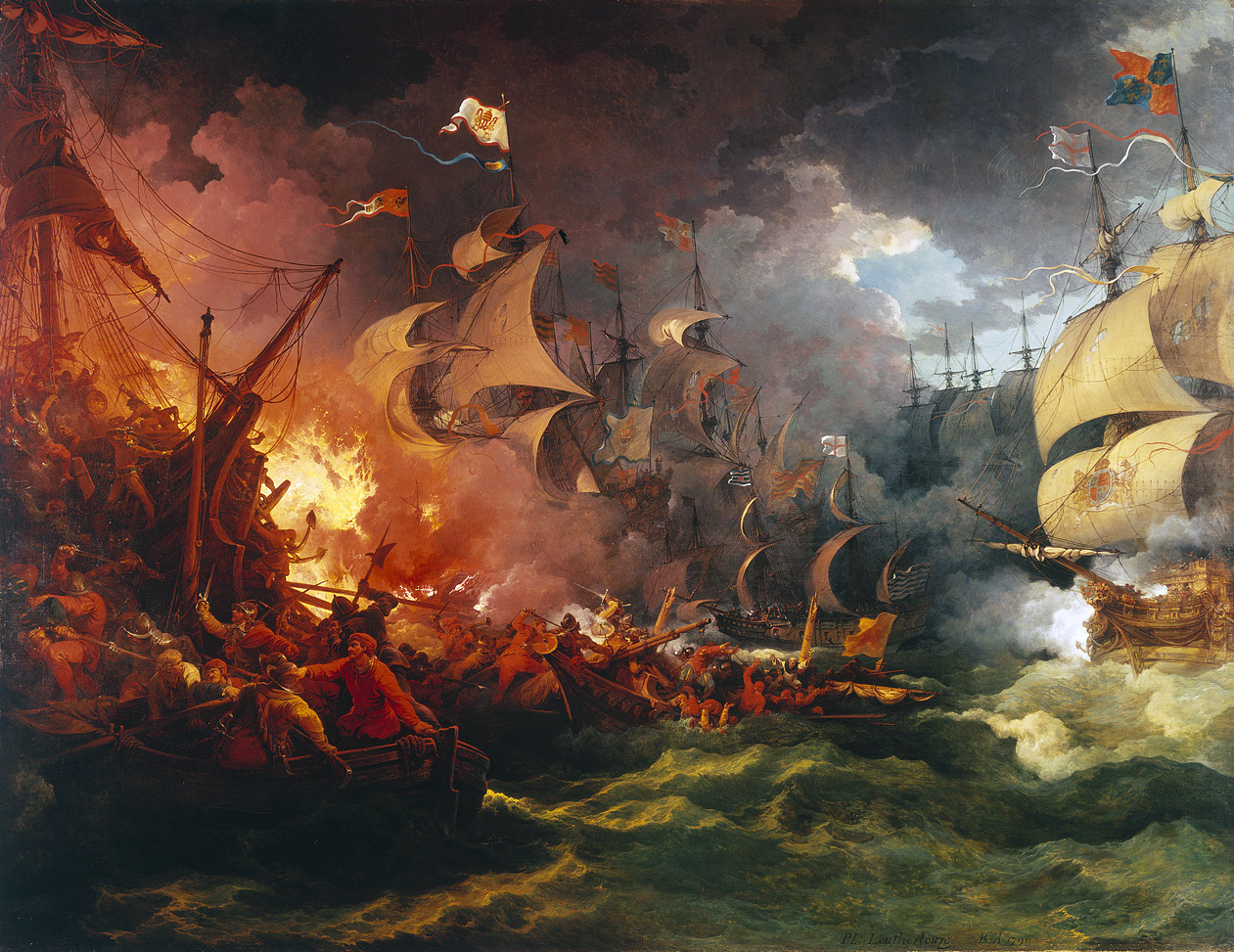
File:Spanish Armada.jpgIn 1588 the Duke of Medina Sidonia sailed to England with his troop, the Spanish Armada, with the intention of overthrowing Queen Elizabeth I. The events leading up to the invasion of the Spanish Armada can be traced back directly to Mary I of England's death. Philip II of Spain and Mary had been married and up until her death he had ruled as the co-monarch of England. When she died he lost his status and this was a troublesome moment in his political history. But it was not only politics which angered Spain enough to attack England, it was religion. Spain was a community of devout Roman Catholics and seeing that a Protestant ruler, Elizabeth I, was to take the throne in England angered them. Politics and religion became intertwined, with the religion of a political leader sparking a crusade, as it was to be called as Pope Sixtus V stood behind the actions of Spain. Even though these are a great many problems, seemingly enough to start a ruthless attack, there was even more discord between the two countries. Elizabeth stood and idly watched as English sailors plundered Spanish ships, which boiled Philip's blood. All of these disagreements and all of that anger came to a head and made Spain send a fleet to invade and attempt to conquer England. The blend of religion and politics was quite a momentous occasion, even if the end result was a brutal massacre.

"The Spanish Armada." Queen Elizabeth I (1533-1603). Web. 16 May 2010. <http://www.elizabethi.org/us/armada/>. 

"CATHOLIC ENCYCLOPEDIA: The Spanish Armada." NEW ADVENT: Home. Web. 16 May 2010. <http://www.newadvent.org/cathen/01727c.htm>.


"File:Spanish Armada.jpg." Wikimedia Commons. Web. 16 May 2010. <http://commons.wikimedia.org/wiki/File:Spanish_Armada.jpg>.