Architecture. It is a precise science which is constantly changing. From the time when buildings were just holes in rock walls to modern times where buildings are more like art that can be lived in all types of architecture have reflected the thought processes of the human mind. Some aspects of buildings were affected by Church theology, others by the capricious whims of humans. The time period that is very prominent for its design in architecture is the Medieval age. This was a time where the buildings, most notably the Church, changed very often. By specifically viewing these Medieval buildings it is indeed possible to “read” a building.
 There were three main types of architecture shown in Medieval buildings the first of which was named accordingly: First Romanesque. This type of architecture is a group of two divisions of architecture, Pre-Romanesque and Early Christian, which in themselves were combinations of Merovingian, Carolingian, Ottonian, and Asturian (http://www.essential-architecture.com/STYLE/STY-100.htm). These facts tend to cause discrepancies and make it hard to differentiate between the subdivisions in this expansive selection. Pre-Romanesque architecture was very alike to Romanesque architecture, which makes it very hard to distinguish between these two types of architecture. The thesis still stands, however, that it can be determined where and when a building was made. The one thing that distinguishes Pre-Romanesque from Romanesque is so very gigantic they seem to not be related after inspection. The defining feature of Romanesque architecture, the magnificent designs which idealized Judgment Day, were absent from Pre-Romanesque designs. Pre-Romanesque was simplistic without a real focus to dwell upon. If a building seems like it links barbarian art to Romanesque art, it is of the Pre-Romanesque era.
Romanesque was the next primary form of architecture in the Medieval period. As mentioned in the previous section, Pre-Romanesque was a prelude to Romanesque and shared many features with it. It had conformed edges, gray stones, and modest designs. But when Pre-Romanesque shifted into Romanesque, it was adopted by the Church and prompted the greatest change in form. The giant arches that framed the entrance now had a picture above them. It was still in gray stone and did not stand out from the rest of the buildings but it no doubt made Romanesque architecture separate from its predecessor. Romanesque architecture centered around Judgment Day. Gigantic depictions of the judging of man stood, displayed in all grandeur, above the entrances to Churches (http://www.sacred-destinations.com/reference/romanesque-architecture). This influence by the Church set precedence for later architectural designs. The architecture reflected the theology of the time, destruction and death. The Churches were designed with the intended use as bunkers for protection from warfare. Buildings designed with thick walls and hidden supports, with designs highlighting Judgment Day, and appeared to be impenetrable when the doors were shut tight are from the Romanesque period of the Medieval age.
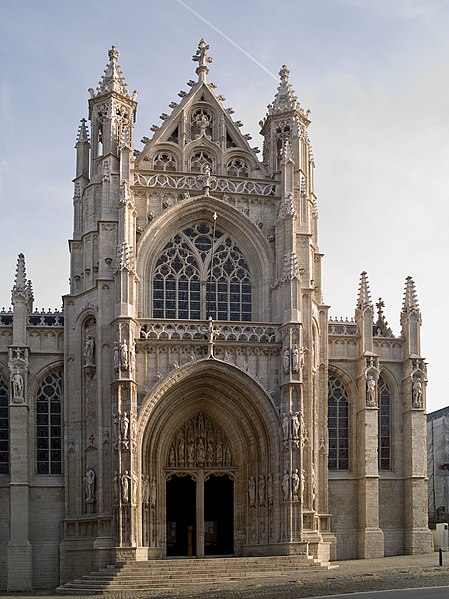
The third main style of architecture prominent in Medieval times was Gothic. This type of art was very detached from the previous types of Medieval architecture. Instead of focusing on Judgment Day, destruction, and death like Romanesque, Gothic focuses on letting the light of God envelope humanity in a loving embrace. This change was not out of the blue nor was it for no apparent reason. Now that the Church and architecture were intertwined, if Church theology changed, architecture had to reflect that. The way in which the architecture reflected this specific change in theology was stained glass windows (http://www.newadvent.org/cathen/06665b.htm ). These windows ranged in designs from just a slew of colors pieced together to showing religious or historical scenes. They tossed the light throughout the Church and played across the floor and anyone who happened to be inside. The walls were made much thinner to allow for windows to be installed closer together. The interpretation of Judgment Day was replaced by an elegantly designed window of stained glass. A building with stained glass windows covering the majority of the walls came from the Gothic period.
"CATHOLIC ENCYCLOPEDIA: Gothic Architecture." NEW ADVENT: Home. Web. 25 Apr. 2010. <http://www.newadvent.org/cathen/06665b.htm>.
"World Architecture Images- Asturian Pre-Romanesque Architecture (Spain and Portugal 711-910)."World Architecture-1000 Places To See Before You Die. Web. 25 Apr. 2010. <http://www.essential-architecture.com/STYLE/STY-100.htm>.
"Romanesque Architecture - Sacred Desitnations Guide to Romanesque Architecture." Sacred Sites at Sacred Destinations - Explore Sacred Sites, Religious Sites, Sacred Places. Web. 25 Apr. 2010. <http://www.sacred-destinations.com/reference/romanesque-architecture>.
"File:Bruxelles Notre-Dame Du Sablon.jpg." Wikimedia Commons. Web. 25 Apr. 2010. <http://commons.wikimedia.org/wiki/File:Bruxelles_Notre-Dame_du_Sablon.jpg>.
"File:St Medard's Priest's Door.jpg." Wikimedia Commons. Web. 25 Apr. 2010. <http://commons.wikimedia.org/wiki/File:St_Medard's_Priest's_Door.jpg>.
"File:Basilique St Rémi De Reims-Façade.jpg." Wikimedia Commons. Web. 25 Apr. 2010. <http://commons.wikimedia.org/wiki/File:Basilique_St_R%C3%A9mi_de_Reims-Fa%C3%A7ade.jpg>.


Some of your prose is a bit unweildy. Take for instance: "These facts tend to cause discrepancies and make it hard to differentiate between the subdivisions in this expansive selection." I don't understand what that means.
ReplyDeleteYou have done a good job finding examples, but the essay would be greatly improved by the inclusion of primary sources. Without them, much of what you suggest in the paper remains conjecture.